Lsat Most Likely to Agree Reading Comprehension
High-yield tips to help you ameliorate your LSAT Reading Comprehension, plus do questions
Part 1: Introduction to the LSAT Reading Comprehension Section
Law students and attorneys alike will emphasize the extensive amounts of reading they must complete. These readings—usually dense, complex, and lengthy—are a staple of the legal profession. Accordingly, in improver to its sections on belittling and logical reasoning, the LSAT tests reading comprehension. From understanding the main point of a passage to making inferences about what the author says, the LSAT Reading Comprehension section evaluates your ability to chop-chop and thoroughly synthesize written material.
The LSAT Reading Comprehension sources texts from a variety of subjects. Sections ofttimes depict from material almost the arts and humanities, science, or topics within law and policy. These articles, which are edited to fit the format of the exam and come in at around 450 to 550 words long, require you lot to procedure big amounts of information and understand how arguments are structured. Oftentimes, you'll need to discern patterns within the text to reply questions and apply the information to other scenarios.
The questions in this section of the exam are designed to be objective and draw solely from the information in the passage. Though some students enjoy the fact that this department does not require whatsoever outside cognition, other students find that this makes the section all the more challenging to prepare for. Despite that claiming, agreement the LSAT Reading Comprehension can assistance you lot prepare and feel more confident, and we're here to provide you with tools that you can use to help increase your LSAT Reading Comprehension score!
Click on the following links for high-yield strategies to utilise on each of the LSAT sections:
Office ii: LSAT Reading Comprehension Section Construction
Each LSAT volition include one graded Reading Comprehension Section. The section is 35 minutes long and includes 26-28 multiple-pick questions. Within the section are 4 passages, each with its own set of questions. On the exam, one of the four passages consists of 2 shorter and related texts, which is a variation chosen Comparative Reading. The other iii passages are unmarried articles. There is no set up society for where the paired passage appears or guild for the passages in general. In other words, the passages don't necessarily get more difficult equally you progress through the test.
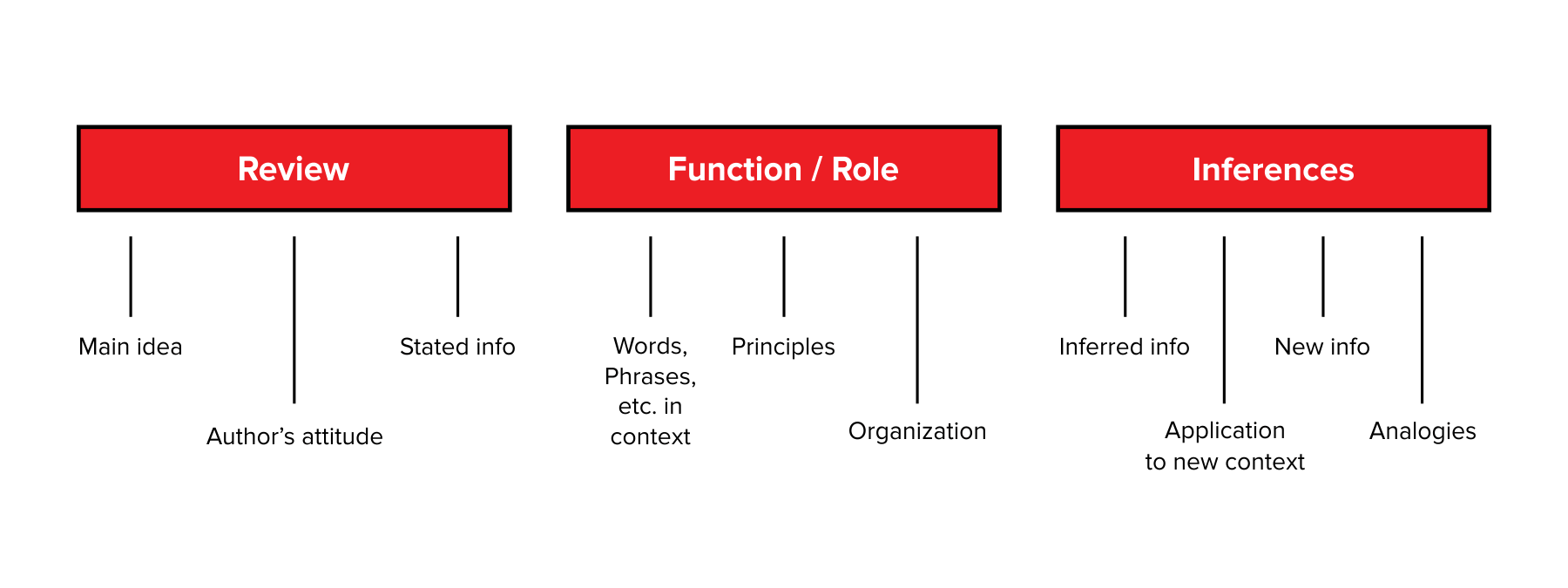
Each question in the section will accept five answer choices. Though several answers may be true, there will only be one right respond. This correct respond will most accurately respond to the question. Each passage will include half dozen-8 questions. LSAC differentiates the topics of the questions as follows: "the principal idea or master purpose, data that is explicitly stated, data or ideas that can be inferred, the meaning or purpose of words or phrases as used in context, the arrangement or structure, the application of the information in the selection to a new context, principles that function in the selection, analogies to claims or arguments in the option, an author'due south attitude as revealed in the tone of a passage or the language used, the affect of new information on claims or arguments in the choice."
Don't worry if this sounds similar a lot—we'll suspension it down for you. Here are the question categories you'll need to exist familiar with:
-
Main idea
-
Stated information
-
Inferred data
-
Word/phrases in context
-
Organization
-
Application
-
Principles
-
Analogies
-
Author's mental attitude
-
New information
Broadly, the questions fall into the categories of reviewing for overall agreement; identifying the office/role of words, phrases, sentences, and paragraphs; and making inferences.
Mostly, each set up of questions begins with a question nigh the main point or purpose of the passage it is evaluating. Each passage will list which questions that specific reading applies to, and questions in the Comparative Reading portion may reference one or both readings in the pair.
Part 3: Frameworks for Approaching the Reading and Questions
There are many ways to arroyo the readings and questions inside the LSAT Reading Comprehension Section. Yous may already know which approach works best for you. However, y'all may also find it helpful to endeavor some alternatives and see how they feel. You may even find that a combination works best or that you switch it up depending on the specific passage. This section provides several options for you lot to consider. In addition, it's of import to point out that these approaches aren't mutually exclusive. In other words, even if you read the passage offset (approach #1), you'll yet need to decide whether you lot consummate the master signal question first or last (approach #four).
Reading Approach #ane: Passage first
With this approach, y'all read through the passage thoroughly and then move onto the questions. You practice non preview the questions first and move on to them only once you take completed reading the text.
Reading Arroyo #2: Questions outset
This approach entails a few steps. You begin past reading that passage's questions. This gives you a preview of what parts of the text the questions volition focus on. If yous come up across a "word/phrase in context" question, highlight the word/phrase in the passage so that when you read the passage, you'll pay shut attention to the highlighted text. Some students who apply this approach then thoroughly read the text with attending to the questions and finally respond the questions after reading the passage in its entirety.
Others, withal, may choose to search for the answers within the text without always reading information technology thoroughly and in its entirety. This tactic should be used with caution. Remember, the LSAT Reading Comprehension Section evaluates your ability to synthesize long and dumbo materials. Therefore, arguments are often built using various portions of the text so scanning for keywords may be insufficient. If y'all are short on time, though, this approach could be helpful.
Reading Approach #three Skim outset
Some examination-takers find information technology helpful to skim the reading and questions apace to get a bones understanding of the topic, structure, and question types. After skimming, you should reread the passage for understanding and then complete the questions.
Reading Approach #4 Master Betoken Question
This approach focuses on main signal questions. Usually, each set of questions begins with a question virtually the main point, purpose, or argument of the passage. Some test-takers complete this question first as information technology appears, while others reserve it for terminal after they've spent fourth dimension answering other questions and exploring the passage in greater particular.
Completing the question offset allows you to confirm your general understanding of the passage earlier moving into more specific questions. Sometimes, however, the main bespeak may have been illuminated from the other questions you read and the assay they required. If you are struggling with the master point question in a passage, or often completing these questions incorrectly, you may desire to try saving it for last.
Reading Arroyo #5 Dorsum and Along
Some people discover it helpful to skim the passage beginning and then slowly complete the questions. Then, these students return to the passage to study it more than in-depth when they encounter a question they cannot complete from memory. This approach can be helpful for saving time because you're only reading slowly the portions of the text that you demand more clarity on.
Reading Arroyo #half dozen From Memory
Another approach involves reading or skimming the passage kickoff and then completing only the questions that you tin answer from memory. One time you consummate these questions, you return to the text to answer the questions that remain. This approach saves time because you're not going dorsum and forth, and instead, you're simply focusing on either the text or the questions.
Reading Approach #7 Fourth dimension Restrictions
One of the main challenges students see with the LSAT Reading Comprehension Section is timing. Yous may find that y'all are not finishing the section before time is called. One solution for this (very common) problem can be setting smaller time restrictions to keep yourself on stride. Two of the well-nigh common frameworks are limiting the time you spend reading the text and limiting the time yous spend on each passage and its questions. Some people find that limiting their reading of the text to ii minutes allows them adequate fourth dimension to reply the questions.
If you need more time to read, you may observe it helpful to instead restrict the time you spend reading and answering questions in total. Since each LSAT Reading Comprehension Department is 35 minutes long and includes 4 sets of readings and questions, some examination-takers notice it helpful to spend only eight-9 minutes on each set up, ensuring that they tin make information technology to each set.
Reading Approach #8 Reordering Passages
The terminal arroyo we'll hash out involves evaluating the order of the reading and question sets before completing them. This arroyo can be particularly useful for those who struggle to complete passages on certain topics or who struggle with completing the full set up of questions. When the department begins, read the kickoff few sentences of each passage and select where to start based on how many questions are asked based on that passage or your level of involvement or comfort in the topic.
Some exam-takers will relieve a passage they deem difficult for last and so they tin can spend more than time with passages they are comfortable with. Others will complete the more difficult passage first to ensure they have ample time to complete it. Generally speaking, it's statistically more beneficial to make sure yous consummate sets that include more than questions and salvage sets that include fewer questions for the end.
Part iv: Comprehension Strategies
The previous section explained ways to read through passages. This department will include strategies to assist you sympathize what y'all read. The LSAT Reading Comprehension Section is designed to test your power to synthesize and apply information. Sometimes, you may detect merely reading through the passage is not quite plenty due to the complication of the passages the examination-writers like to give students. Below is a sample passage, followed past strategies to help you lot understand readings in the LSAT Reading Comprehension Section and examples of how to apply them to this sample passage:
Without symbolism at that place can be no literature; indeed, non even language. What are words themselves only symbols, almost equally capricious as the messages which compose them, mere sounds of the voice to which we accept agreed to give certain significations, as nosotros have agreed to interpret these sounds by those combinations of letters? Symbolism began with the beginning words uttered by the starting time homo, as he named every living thing; or before them, in heaven, when God named the globe into being. And we see, in these beginnings, precisely what Symbolism in literature actually is: a course of expression, at the all-time simply approximate, essentially merely arbitrary, until it has obtained the force of a convention, for an unseen reality apprehended by the consciousness. It is sometimes permitted to u.s. to promise that our convention is indeed the reflection rather than merely the sign of that unseen reality. We have done much if we have plant a recognizable sign.
"A symbol," says Comte Goblet d'Alviella, in his book on The Migration of Symbols, "might be defined as a representation which does not aim at being a reproduction." Gradually the word extended its pregnant, until it came to denote every conventional representation of idea by form, of the unseen by the visible. "In a Symbol," says Carlyle, "there is concealment and however revelation: hence, therefore, by Silence and by Speech communication acting together, comes a double significance." And, in that fine affiliate of Sartor Resartus, he goes further, vindicating for the word its full value: "In the Symbol proper, what we can call a Symbol, there is ever, more or less distinctly and directly, some embodiment and revelation of the Space; the Infinite is made to blend itself with the Finite, to stand visible, and as it were, attainable there."
It is in such a sense equally this that the word Symbolism has been used to describe a move which, during the last generation, has profoundly influenced the course of French literature. All such words, used of anything so living, variable, and irresponsible as literature, are, equally symbols themselves must then ofttimes be, mere compromises, mere indications. Symbolism, as seen in the writers of our twenty-four hour period, would accept no value if it were non seen likewise, under ane disguise or another, in every great imaginative writer. What distinguishes the Symbolism of our solar day from the Symbolism of the past; is that it has now become conscious of itself. The forces which mold the thought of men alter, or men's resistance to them slackens; with the modify of men'south thought comes a change of literature, and with it comes a literature in which the visible earth is no longer a reality, and the unseen world no longer a dream.
This passage has been adapted from the following source: Arthur Symons. (1919). The Symbolist Movement in Literature. E.P. Dutton & Visitor, New York. Project Gutenberg. Retrieved December 20, 2020, from https://www.gutenberg.org/ebooks/53849.
Comprehension Strategy #1: Active Outlining
In this strategy, you use your scratch paper during the reading section to outline the text equally you lot read. Some students create i flowing outline while others notice it helpful to split their outline past paragraphs so they can quickly locate material in the text. For this strategy, you build your outline while you lot read, jotting downward and connecting relevant information as you lot go. Considering y'all are trying to annotation and relate relevant information, y'all should balance between documenting likewise much and as well petty text. A good strategy is to make notes every few sentences or between paragraphs.
Hither's an example of an outline of the passage higher up:
Paragraph 1
-
No symbolism=no literature/language, words/letters/sounds=symbols
-
Began with first words spoken…symbolism is a form of approximate expression
-
Convention yields recognizable pregnant, but not necessarily reflection
Paragraph 2
-
Comte: symbol=representation not reproduction, concealment & revelation
Paragraph 3
-
Naming of Symbolist motility is in line with Comte'southward understanding of symbol
-
Motility has influenced form of French literature
-
Symbolism is employed by every great imaginative author
-
Current symbolism is different because it's conscious, change in literature comes from change in thought
-
Conscious symbolism: visible world =/= reality, unseen =/= unknown
Every bit yous tin see from the in a higher place outline, shorthand is an effective way to convey meaning without wasting precious fourth dimension writing data. Yous should write in whatsoever autograph is legible and efficient for you. LSAT Reading Comprehension Section passages are circuitous but well-written. Arguments may not be piece of cake to grasp, but they will be clearly laid out. For this reason, you may often find the chief point in the first or last sentence of the text, and your outline should make annotation of those as the exam-writers love to drill those points abode.
There are some other important pieces of information you lot should make note of every bit you move through a passage. For example, information technology can also be helpful to include outside perspectives that are referenced in the text and whether the speaker agrees or not. Additionally, definitions and dates may exist informative points to add to your outline. Further, noting and connecting causes and effects can help you understand the layers of a writer's argument.
The almost helpful outlines will help you understand the structure of the reading and where to hands locate relevant content. This strategy may take time and practice to develop and complete chop-chop, but it can exist very helpful for understanding circuitous passages, especially when they are about topics with which you are unfamiliar.
Comprehension Strategy #ii: Kickoff and Last Lines
Another strategy for agreement an LSAT Reading Comprehension Section passage focuses on the first and terminal few lines of each paragraph. Rather than focus on the reading in total like the outline in a higher place, you would create notes or an outline synthesizing the openings and closing of the paragraphs.
Annotation: We primarily recommend this strategy for students who tend to run out of time and want to scrape an extra point or two out of a department. While we recommend focusing your notes on the start and last lines of a paragraph in this strategy, nosotros still recommend reading all of the passage.
This strategy works because fifty-fifty though LSAT readings are very dumbo, they are still well-organized. That means that sentences and paragraphs clearly relate and build upon one another, so you can unremarkably grasp the information by agreement where the statement begins and ends.
Focusing on the beginning and stop of paragraphs tin assist you hands decipher the broader patterns of the text without being bogged down by too many details.
An example of notes taken using this strategy is shown below:
Paragraph 1
-
No symbolism=no literature/language, words/letters/sounds=symbols
-
Symbolism at best can produce recognizable pregnant, only not necessarily reflection
Paragraph ii
-
Comte: symbol=representation not reproduction, concealment & revelation
-
Symbols alloy space and finite
Paragraph 3
-
Naming of impactful Symbolist motion is in line with Comte's understanding of symbol
-
Current symbolism is different because its conscious: visible globe =/= reality, unseen =/= unknown
This strategy yields shorter notes and can assist yous focus on but the virtually important parts. You lot should especially consider this strategy if yous struggle with running out of time on the test.
Comprehension Strategy #three: Connect the Dots
This strategy is very similar to the last two, except instead of generating your notes as yous read, yous compile them afterward you've read the text. Sometimes, the patterns and connections in the text may not be immediately clear. You may discover information technology helpful to summarize your thoughts after y'all've read the passage in total. Here's an example of a summary you might write based on our instance passage:
Symbolism is essential to literature. It is a form of approximate expression that gains meaning through convention. A symbol represents without reproducing (revelation & concealment). Symbolism is employed by every nifty writer, but the movement being described has impacted French literature because of its version of symbolism which is aware of itself
Comprehension Strategy #4: LSAT Interface Tools
This strategy can exist used in combination with the previous strategies or on its ain if you prefer to but use the tablet and not scratch paper. Since the highlighter tool has iii colors, you lot may want to devise a organization for using those colors. You lot tin assign colors to specific types of information including dates, speakers, tone, and definitions. Y'all may also assign a specific meaning to the text that y'all underline. Going into the exam with a pre-determined system that you are familiar with and have practiced many times tin can relieve time and aid you generate notes that are helpful and easy to understand.
Deciding on a strategy approach
In that location are several different reading and comprehension strategies that we've presented, and it'south of import to use a methodical approach to detect which works best for you. To practice this, complete the following steps:
-
List every strategy or combination of strategies that yous'd similar to endeavor.
-
Understand each strategy on your list by referring dorsum to this guide.
-
Practice each strategy on at to the lowest degree six to vii dissimilar passages. Try to detect passages that range from easy to hard.
-
Calculate the pct of questions you go correct from each strategy.
-
Select the strategy that helped yous get the virtually questions correct! After on, you may find modifications to this initial strategy selection that help you even more.
Function five: Tackling the Question
Now that you understand ways to read through the text, understand the passage, and the question types y'all may encounter, let'due south become ready to reply the questions. Instance phrasings of question types are listed below:
-
Which one of the post-obit best represents the main signal of the passage?
-
Each of the following is mentioned in the text EXCEPT?
-
Which of the following can about accurately exist inferred from the text?
-
Which of the following best describes the role of the 2nd paragraph?
-
Which of the post-obit best describes the construction of the passage?
-
application
-
Which of the following principles is supported past the text?
-
The author would most likely concur with which of the following statements?
-
Which of the post-obit is most shut to the relationship described in the passage?
-
Which one of the following virtually closely represents the author'due south attitude toward the field of study?
-
Which of the post-obit, if truthful, would most weaken the argument in the passage?
Once you lot empathize the question being asked, you tin can attempt to reply it. Here are some tools yous tin can use to evaluate the answer choices. Remember, each question will have v answer choices. Though an answer choice may be true, it might not necessarily be the correct respond. The correct respond will all-time and near accurately answer the question. Like we mentioned before, no outside knowledge will exist necessary to reply the questions. Equally a consequence, you lot should only use the information presented in the text to answer the question.
Note: For this department of the exam, if you have to brand an assumption based on your ain outside cognition to justify an answer choice, odds are that that answer selection is wrong!
Correct answers will have clear ties to the text. Since the LSAT must only include questions that don't require external knowledge, the support for the answer must exist inside the passage. Right answers volition exist true inside the framework of the passage, connected to and supported by the text, and reply the question. It is of import to notation that just because an answer is truthful and/or in the text does not mean it is the correct answer. Sometimes, the LSAT Reading Comprehension Section will include answer choices with those traits to throw y'all off, encouraging you to select an incorrect answer choice but because yous saw it in the passage.
Incorrect answers will either not exist supported by the text, contradict the text, or non address the question at paw. Dissimilar the right answers, which need all three qualities, the incorrect answer needs only one of these qualities to be wrong. Every bit mentioned earlier, incorrect answers will oft include near-verbatim excerpts from the text, just with keywords slyly changed or added that modify the meaning. Therefore, it is of import to make sure you are carefully reading the questions and answers in order to avert these traps.
The to a higher place descriptions of correct and incorrect answer choices are by and large true. The exception is (ironically) for questions that land "EXCEPT" in their question stem. On these questions, yous are often instead of looking for four supported answers and one unsupported respond. These types of questions will e'er have the "except" written in all caps, just you still need to be sure to read the question carefully and in full.
As you lot evaluate the answers, wait for words that show the answer is unsupported by the text. Call back, unless it is an "except" question, an unsupported answer is wrong. So, when you lot encounter an reply choice that is unsupported by or contradictory to the text, you can movement to the next reply. When you select your answer option for not-"except" questions, you should exist able to reference the part of the text that supports it.
TIP: Whatever time you select the respond to a question, you should be able to draw a line betwixt the answer you choose and the verbal line in the passage that supports information technology!
If after initially reading the answers, y'all're nevertheless deciding between multiple answers, you may find it helpful to either reread the answer choices or go dorsum to the text to compare the choices to the passage, evaluating the choices for if they are supported and unsupported. Inquire yourself the post-obit questions:
-
Which answer choice has more back up from the passage?
-
Is there anything that the passage states that gives me any indication that makes one of the answer choices less correct than the other answer choice?
-
Did I reread the question stalk? Which answer choice virtually accurately answers what the question asks?
Remember, incorrect answer choices volition often contradict the text, not be supported by the text, not accost the question at hand, or have a almost-verbatim quote with its pregnant changed.
Function 6: Practice Passage and Questions
While the majority of Louis Brandeis's great progressive achievements have been connected with the industrial arrangement, some have been political in a more limited sense. On aught has he e'er worked harder than on his diagnosis of the Money Trust, and when his life comes to be written this will exist ranked with his railroad work for its result in accelerating industrial changes. It is indeed more than a coincidence that and then many of the things he has been contending for have come up to pass. It is seldom that ane man puts one thought, not to say many ideas, effectively before the earth, just it is no exaggeration to say that Mr. Brandeis is responsible for the at present widespread recognition of the inherent weakness of cracking size.
He was the first person who set forth effectively the doctrine that there is a limit to the size of greatest efficiency, and the successful demonstration of that truth is a profound contribution to the subject of trusts. The demonstration is powerfully put in his testimony before the Senate Committee in 1911, and it is powerfully put in this volume. In destroying the delusion that efficiency was a common incident of size, he emphasized the possibility of efficiency through intensive development of the individual, thus connecting this principle with his whole study of efficiency, and pointing the way to industrial commonwealth.
Not less notable than the intellect and the constructive ability that take gone into Mr. Brandeis's work are the infrequent moral qualities. Any powerful and entirely sincere crusader must sacrifice much. Mr. Brandeis has sacrificed much in money, in conjuration of social life, in effort, and he has done information technology for principle and for homo happiness. His power of intensive work, his sustained involvement and will, and his backbone have been necessary for leadership. No man could have done what he has done without existence willing to devote his life to making his dreams come up true.
Nor should anyone brand the mistake, because the labors of Mr. Brandeis and others have recently brought about changes, that the system which was existence attacked has been undermined. The currency bill has been passed, and as these words are written, it looks as if a group of trust bills would be passed. Simply systems are not ended in a day. Of the truths which are embodied in the essays printed in this volume, some are existence carried out now, simply information technology will exist many, many years earlier the whole idea can exist made effective; and there will, therefore, exist many, many years during which agile citizens volition be struggling for those principles which are so clearly, so eloquently, and so conclusively set forth in his book Other People'southward Coin.
This passage has been adjusted from the post-obit source: Louis Dembitz Brandeis. (1914). Other People'south Money and How the Bankers Utilise Information technology. Frederick A. Stokes Visitor, New York. Project Gutenberg. Retrieved Dec 20, 2020, from https://www.gutenberg.org/ebooks/57819.
Practise Question 1: What is the main bespeak of the passage?
A) Louis Brandeis was an innovative entrepreneur who accomplished all of his goals for improving society.
B) Of all his endeavors, Louis Brandeis worked the hardest on his diagnosis of the Coin Trust, which accelerated industrial changes.
C) Louis Brandeis's most impactful accomplishment was setting along the doctrine that at that place is a limit of greatest efficiency, which immediately created industrial commonwealth.
D) Louis Brandeis set forth many industrial and societal improvements, laying the foundation for development that continued after his death.
E) Louis Brandeis was both a good and intelligent person who worked extremely hard to achieve his goals.
Exercise Question 2: The author's feelings toward Louis Brandeis can past characterized each of the following EXCEPT:
A) Neutrality
B) Respect
C) Praise
D) Admiration
E) Gratitude
Practice Question 3: Based on the passage, the authors believe Louis Brandeis's ideas and work contributed to which of the post-obit:
A) Republic
B) Net neutrality
C) Currency bills
D) Philanthropy
E) Railroad worker rights
Practice Question 4: Based on the passage, the writer most probable uses the word "delusion" in the second paragraph to hateful which of the following:
A) Deception
B) Exaggeration
C) Propaganda
D) Silliness
E) Misconception
Practice Question v: Based on the passage, it is most likely that the author values people that are each of the post-obit EXCEPT:
A) Tenacious
B) Timid
C) Courageous
D) Eloquence
E) Sincere
Exercise Question 6: Based on the passage, which of the following was most likely a theme across some of Louis Brandeis's work:
A) Cooperative economics
B) Efficiency
C) Republic
D) Equality
Eastward) Equity
Answer key for practice questions
ane. Answer choice D is correct. This answer fairly connects the components of the author's statement to synthesize an accurate decision. Reply choices A, B, and C each accept components that are in contradiction to the text or unsupported by the text. Respond option E, though true inside and supported by the text, does not actually address the question. Information technology provides show rather than the main point.
2. Answer choice A is right. The author'south tone towards Brandeis is very positive. There are no details offered to suggest neutrality on the author's role.
3. Answer choice C is right. The fourth paragraph explains that the piece of work of Brandeis and others accept created changes, including a currency pecker. Answer pick A may wait appealing considering the text references "industrial" democracy, only democracy, in full general, is not supported by the text. Similarly, choice C, philanthropy, should not be conflated with the text's mention of "sacrifice" in the third paragraph, and though the article references the railroad, it does not say what Brandeis's specific piece of work on the affair was, so answer choice D is incorrect as well. Answer choice B is entirely unsupported by the text.
4. Respond choice E is correct. The text says that Brandeis "emphasized the possibility of efficiency," which suggests the mirage was a byproduct of misunderstanding or lack of imagination. Further, the incorrect answer choices do not lucifer the tone of the sentence beingness referenced. The correct answer choice when exchanged with the give-and-take being referenced, maintains the meaning of the original sentence.
5. Answer choice B is correct. The other answer choices are conspicuously supported by the text--they are qualities that the author praises. Since this is an "except" question, the correct reply will not be supported by the text. There is zero to suggest that he was timid or that was a trait the writer valued. The author instead notes that Brandeis was courageous and progressive.
6. Answer choice B is correct. Reply choice B is supported by the final sentence of paragraph two, which points out that Brandeis has a broader written report of efficiency into which other of his inquiries fit. Answer choice is A is not referenced inside the text. Reply choice C is not referenced in the text and should not be conflated with "industrial democracy." Answer choices D and Eastward, though they could be true, are likewise not referenced within the text. Further, they are almost synonymous, which suggests that they are wrong since only one could exist right.
Part vii: Ofttimes Asked Questions
How is the LSAT Reading Comprehension Department graded? Like all of the multiple-selection sections on the LSAT, each correct answer receives one point. Each incorrect response receives zero points. There is no penalty for an incorrect response. The section will include 26-28 questions. The questions on the Reading Comprehension Section count the same as the questions in the other sections, with each question being worth one signal counting towards your full number of correct answers.
How do I become faster at reading the passages? If you lot struggle with reading rapidly, the LSAT Reading Comprehension Department tin be very frustrating. What slows downwards many readers is how complex the readings are, in addition to non being familiar with the very niche topics many of the passages cover. Practice makes perfect, so try taking as many do tests as possible. You may too find it helpful to read academic articles in areas you're unfamiliar with so you can practise synthesizing and contextualizing complex readings.
In add-on, please wait at some of the reading approaches and comprehension strategies included in this guide. Many of them are designed to maximize your efficiency and prevent you from spending as well much fourth dimension on inconsequential details and passage fluff.
Is the LSAT Reading Comprehension Section weighted differently from other sections? Each question on the LSAT Reading Comprehension department is worth the same as the multiple-selection questions in other sections. However, the LSAT Reading Comprehension Section has the largest number of questions, with 26-28 questions per section. You can view an article nearly LSAT scoring here.
Is the LSAT taken online?
Start in September 2019, the LSAT switched from a paper and pencil format to digital in the The states (including Puerto Rico and the U.South. Virgin Islands) and Canada. The exam is completed on tablets. Though the format inverse, the test structure and contents did not. LSAC offers tools to become familiar with the testing platform.
Within the digital LSAT Reading Comprehension Department, yous can toggle between passages and flag specific questions. For viewing the passage, you may scroll the passage alongside the questions or view only the passage. Considering the size of the text is adjustable, the lines are non numbered. Questions referencing specific parts of the text will highlight that text on-screen. You cannot annotate the text, but you tin can utilise a highlight tool in pink, yellow, and orange. There is also an underlining tool. You will have scratch paper available to brand notes on.
jaramillosibleard.blogspot.com
Source: https://www.shemmassianconsulting.com/blog/lsat-reading-comprehension

Postar um comentário for "Lsat Most Likely to Agree Reading Comprehension"