The Roots of Postmodern Theatre Can Be Located in the Arts Phenomenon Called
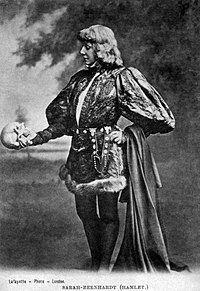
Theatre or theater [a] is a collaborative form of performing art that uses alive performers, usually actors or actresses, to present the experience of a real or imagined event before a live audience in a specific place, often a stage. The performers may communicate this experience to the audition through combinations of gesture, spoken communication, vocal, music, and dance. Elements of art, such as painted scenery and stagecraft such as lighting are used to enhance the physicality, presence and immediacy of the experience.[1] The specific place of the functioning is too named by the discussion "theatre" as derived from the Ancient Greek θέατρον (théatron, "a place for viewing"), itself from θεάομαι (theáomai, "to meet", "to lookout", "to observe").
Modern Western theatre comes, in big measure, from the theatre of ancient Hellenic republic, from which it borrows technical terminology, classification into genres, and many of its themes, stock characters, and plot elements. Theatre artist Patrice Pavis defines theatricality, theatrical language, stage writing and the specificity of theatre as synonymous expressions that differentiate theatre from the other performing arts, literature and the arts in general.[2] [b]
Modern theatre includes performances of plays and musical theatre. The art forms of ballet and opera are besides theatre and use many conventions such equally acting, costumes and staging. They were influential to the evolution of musical theatre; see those articles for more data.
History of theatre [edit]
Classical and Hellenistic Hellenic republic [edit]

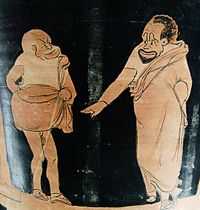
A depiction of actors playing the roles of a primary (right) and his slave (left) in a Greek phlyax play, circa 350/340 BCE
The city-state of Athens is where western theatre originated.[3] [4] [five] [c] It was part of a broader culture of theatricality and functioning in classical Hellenic republic that included festivals, religious rituals, politics, police, athletics and gymnastics, music, poetry, weddings, funerals, and symposia.[vi] [five] [7] [8] [d]
Participation in the city-state's many festivals—and mandatory attendance at the City Dionysia every bit an audience fellow member (or even as a participant in the theatrical productions) in particular—was an of import part of citizenship.[10] Civic participation also involved the evaluation of the rhetoric of orators evidenced in performances in the constabulary-court or political assembly, both of which were understood as analogous to the theatre and increasingly came to absorb its dramatic vocabulary.[11] [12] The Greeks also adult the concepts of dramatic criticism and theatre architecture.[13] [14] [fifteen] Actors were either apprentice or at best semi-professional.[xvi] The theatre of ancient Greece consisted of three types of drama: tragedy, comedy, and the satyr play.[17]
The origins of theatre in ancient Greece, according to Aristotle (384–322 BCE), the beginning theoretician of theatre, are to be establish in the festivals that honoured Dionysus. The performances were given in semi-circular auditoria cut into hillsides, capable of seating ten,000–20,000 people. The stage consisted of a dancing flooring (orchestra), dressing room and scene-building area (skene). Since the words were the virtually important part, good acoustics and clear delivery were paramount. The actors (always men) wore masks advisable to the characters they represented, and each might play several parts.[18]
Athenian tragedy—the oldest surviving form of tragedy—is a type of dance-drama that formed an of import part of the theatrical culture of the city-state.[3] [4] [v] [19] [20] [eastward] Having emerged former during the 6th century BCE, it flowered during the fifth century BCE (from the end of which it began to spread throughout the Greek earth), and continued to be popular until the offset of the Hellenistic period.[22] [23] [four] [f]
No tragedies from the 6th century BCE and only 32 of the more than a one thousand that were performed in during the fifth century BCE have survived.[25] [26] [chiliad] We have complete texts extant by Aeschylus, Sophocles, and Euripides.[27] [h] The origins of tragedy remain obscure, though by the 5th century BCE it was institutionalised in competitions (agon) held equally part of festivities jubilant Dionysus (the god of wine and fertility).[28] [29] As contestants in the City Dionysia's competition (the nigh prestigious of the festivals to phase drama) playwrights were required to present a tetralogy of plays (though the individual works were not necessarily connected by story or theme), which commonly consisted of three tragedies and ane satyr play.[thirty] [31] [i] The performance of tragedies at the City Dionysia may have begun equally early as 534 BCE; official records (didaskaliai) begin from 501 BCE, when the satyr play was introduced.[32] [30] [j]
Most Athenian tragedies dramatise events from Greek mythology, though The Persians—which stages the Persian response to news of their military defeat at the Battle of Salamis in 480 BCE—is the notable exception in the surviving drama.[thirty] [k] When Aeschylus won first prize for information technology at the City Dionysia in 472 BCE, he had been writing tragedies for more than than 25 years, all the same its tragic treatment of recent history is the earliest example of drama to survive.[thirty] [34] More 130 years subsequently, the philosopher Aristotle analysed 5th-century Athenian tragedy in the oldest surviving work of dramatic theory—his Poetics (c. 335 BCE).
Athenian comedy is conventionally divided into 3 periods, "Old Comedy", "Middle One-act", and "New One-act". Sometime Comedy survives today largely in the class of the eleven surviving plays of Aristophanes, while Center One-act is largely lost (preserved only in relatively short fragments in authors such every bit Athenaeus of Naucratis). New Comedy is known primarily from the substantial papyrus fragments of Menander. Aristotle defined comedy equally a representation of laughable people that involves some kind of corrigendum or ugliness that does non cause pain or disaster.[50]
In addition to the categories of one-act and tragedy at the City Dionysia, the festival likewise included the Satyr Play. Finding its origins in rural, agricultural rituals defended to Dionysus, the satyr play eventually found its manner to Athens in its most well-known course. Satyr's themselves were tied to the god Dionysus as his loyal woodland companions, ofttimes engaging in drunken revelry and mischief at his side. The satyr play itself was classified as tragicomedy, erring on the side of the more than modern burlesque traditions of the early twentieth century. The plotlines of the plays were typically concerned with the dealings of the pantheon of Gods and their involvement in human diplomacy, backed by the chorus of Satyrs. Still, according to Webster, satyr actors did not e'er perform typical satyr deportment and would break from the acting traditions assigned to the grapheme blazon of a mythical forest creature.[35]
Roman theatre [edit]

Mosaic depicting masked actors in a play: two women consult a "witch"
Western theatre developed and expanded considerably under the Romans. The Roman historian Livy wrote that the Romans first experienced theatre in the 4th century BCE, with a performance by Etruscan actors.[36] Beacham argues that they had been familiar with "pre-theatrical practices" for some time before that recorded contact.[37] The theatre of ancient Rome was a thriving and diverse art class, ranging from festival performances of street theatre, nude dancing, and acrobatics, to the staging of Plautus's broadly highly-seasoned situation comedies, to the loftier-style, verbally elaborate tragedies of Seneca. Although Rome had a native tradition of performance, the Hellenization of Roman civilisation in the 3rd century BCE had a profound and energizing result on Roman theatre and encouraged the development of Latin literature of the highest quality for the phase. The only surviving plays from the Roman Empire are x dramas attributed to Lucius Annaeus Seneca (4 BCE–65 CE), the Corduba-born Stoic philosopher and tutor of Nero.[38]
Indian theatre [edit]

Koothu is an aboriginal form of performing art that originated in early Tamilakam.
The earliest-surviving fragments of Sanskrit drama date from the 1st century CE.[39] [xl] The wealth of archeological show from before periods offers no indication of the being of a tradition of theatre.[41] The ancient Vedas (hymns from between 1500 and 1000 BCE that are among the earliest examples of literature in the world) contain no hint of information technology (although a modest number are composed in a form of dialogue) and the rituals of the Vedic menstruation practise not appear to have adult into theatre.[41] The Mahābhāṣya past Patañjali contains the earliest reference to what may have been the seeds of Sanskrit drama.[42] This treatise on grammer from 140 BCE provides a feasible date for the beginnings of theatre in India.[42]
The major source of evidence for Sanskrit theatre is A Treatise on Theatre (Nātyaśāstra), a compendium whose date of composition is uncertain (estimates range from 200 BCE to 200 CE) and whose authorship is attributed to Bharata Muni. The Treatise is the most complete work of dramaturgy in the ancient world. Information technology addresses acting, dance, music, dramatic construction, architecture, costuming, brand-upwards, props, the organisation of companies, the audience, competitions, and offers a mythological account of the origin of theatre.[42] In doing so, it provides indications about the nature of actual theatrical practices. Sanskrit theatre was performed on sacred ground by priests who had been trained in the necessary skills (dance, music, and recitation) in a [hereditary procedure]. Its aim was both to educate and to entertain.
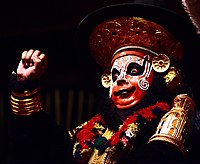
Under the patronage of purple courts, performers belonged to professional person companies that were directed by a phase manager (sutradhara), who may also take acted.[39] [42] This task was thought of as beingness analogous to that of a puppeteer—the literal meaning of "sutradhara" is "holder of the strings or threads".[42] The performers were trained rigorously in vocal and physical technique.[43] There were no prohibitions against female performers; companies were all-male, all-female, and of mixed gender. Certain sentiments were considered inappropriate for men to enact, however, and were thought better suited to women. Some performers played characters their ain historic period, while others played ages different from their own (whether younger or older). Of all the elements of theatre, the Treatise gives nigh attention to acting (abhinaya), which consists of two styles: realistic (lokadharmi) and conventional (natyadharmi), though the major focus is on the latter.[43] [yard]
Its drama is regarded as the highest accomplishment of Sanskrit literature.[39] Information technology utilised stock characters, such as the hero (nayaka), heroine (nayika), or clown (vidusaka). Actors may have specialised in a detail type. Kālidāsa in the 1st century BCE, is arguably considered to exist ancient India's greatest Sanskrit dramatist. 3 famous romantic plays written past Kālidāsa are the Mālavikāgnimitram (Mālavikā and Agnimitra), Vikramuurvashiiya (Pertaining to Vikrama and Urvashi), and Abhijñānaśākuntala (The Recognition of Shakuntala). The final was inspired past a story in the Mahabharata and is the nigh famous. Information technology was the outset to be translated into English and German. Śakuntalā (in English translation) influenced Goethe's Faust (1808–1832).[39]
The side by side great Indian dramatist was Bhavabhuti (c. 7th century CE). He is said to take written the following three plays: Malati-Madhava, Mahaviracharita and Uttar Ramacharita. Among these iii, the last two cover betwixt them the entire epic of Ramayana. The powerful Indian emperor Harsha (606–648) is credited with having written 3 plays: the comedy Ratnavali, Priyadarsika, and the Buddhist drama Nagananda.
Chinese theatre [edit]
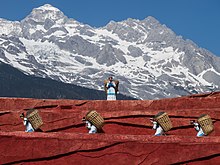
Public performance in Jade Dragon Snow Mountain Open Air Theatre
The Tang dynasty is sometimes known as "The Age of 1000 Entertainments". During this era, Ming Huang formed an acting school known as The Pear Garden to produce a form of drama that was primarily musical. That is why actors are usually called "Children of the Pear Garden." During the dynasty of Empress Ling, shadow puppetry first emerged every bit a recognized form of theatre in China. There were two distinct forms of shadow puppetry, Pekingese (northern) and Cantonese (southern). The two styles were differentiated by the method of making the puppets and the positioning of the rods on the puppets, as opposed to the type of play performed past the puppets. Both styles generally performed plays depicting great adventure and fantasy, rarely was this very stylized form of theatre used for political propaganda.
Cantonese shadow puppets were the larger of the two. They were built using thick leather which created more substantial shadows. Symbolic colour was also very prevalent; a black face represented honesty, a red 1 bravery. The rods used to control Cantonese puppets were attached perpendicular to the puppets' heads. Thus, they were not seen by the audience when the shadow was created. Pekingese puppets were more delicate and smaller. They were created out of thin, translucent leather (usually taken from the belly of a donkey). They were painted with vibrant paints, thus they cast a very colorful shadow. The thin rods which controlled their movements were attached to a leather collar at the neck of the puppet. The rods ran parallel to the bodies of the puppet then turned at a xc degree angle to connect to the cervix. While these rods were visible when the shadow was bandage, they laid outside the shadow of the puppet; thus they did not interfere with the advent of the effigy. The rods attached at the necks to facilitate the employ of multiple heads with i torso. When the heads were not beingness used, they were stored in a muslin volume or cloth lined box. The heads were always removed at dark. This was in keeping with the former superstition that if left intact, the puppets would come to life at night. Some puppeteers went then far every bit to store the heads in one book and the bodies in another, to farther reduce the possibility of reanimating puppets. Shadow puppetry is said to accept reached its highest point of creative development in the eleventh century before condign a tool of the government.
In the Vocal dynasty, at that place were many pop plays involving acrobatics and music. These adult in the Yuan dynasty into a more sophisticated form known as zaju, with a four- or five-act structure. Yuan drama spread across Mainland china and diversified into numerous regional forms, one of the best known of which is Peking Opera which is yet popular today.
Xiangsheng is a certain traditional Chinese comedic operation in the forms of monologue or dialogue.
Indonesian theatre [edit]

In Indonesia, theatre performances accept get an important part of local culture, theatre performances in Indonesia have been adult for thousands of years. Most of Indonesia's oldest theatre forms are linked directly to local literary traditions (oral and written). The prominent puppet theatres — wayang golek (wooden rod-puppet play) of the Sundanese and wayang kulit (leather shadow-boob play) of the Javanese and Balinese—draw much of their repertoire from indigenized versions of the Ramayana and Mahabharata. These tales too provide source material for the wayang wong (human theatre) of Java and Bali, which uses actors. Some wayang golek performances, nevertheless, also nowadays Muslim stories, called menak.[44] [45] Wayang is an ancient class of storytelling that renowned for its elaborate puppet/human and circuitous musical styles.[46] The earliest show is from the late 1st millennium CE, in medieval-era texts and archeological sites.[47] The oldest known record that concerns wayang is from the 9th century. Around 840 Advertizing an Old Javanese (Kawi) inscriptions called Jaha Inscriptions issued by Maharaja Sri Lokapalaform Medang Kingdom in Central Java mentions iii sorts of performers: atapukan, aringgit, and abanol. Aringgit means Wayang puppet show, Atapukan means Mask trip the light fantastic show, and abanwal means joke art. Ringgit is described in an 11th-century Javanese verse form equally a leather shadow figure.
Post-classical theatre in the West [edit]
Theatre took on many culling forms in the Westward between the 15th and 19th centuries, including commedia dell'arte and melodrama. The general tendency was away from the poetic drama of the Greeks and the Renaissance and toward a more naturalistic prose style of dialogue, especially following the Industrial Revolution.[48]
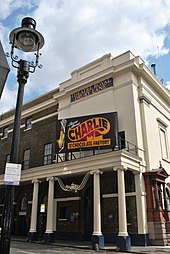
Theatre took a big pause during 1642 and 1660 in England because of the Puritan Interregnum. Viewing theatre every bit sinful, the Puritans ordered the closure of London theatres in 1642.[l] On 24 January 1643, the actors protested confronting the ban by writing a pamphlet titled The Actors remonstrance or complaint for the silencing of their profession, and adjournment from their severall play-houses.[51] This brackish period ended once Charles 2 came back to the throne in 1660 in the Restoration. Theatre (amid other arts) exploded, with influence from French civilisation, since Charles had been exiled in France in the years previous to his reign.
In 1660, 2 companies were licensed to perform, the Duke'southward Company and the Rex'south Company. Performances were held in converted buildings, such every bit Lisle'southward Lawn tennis Court. The starting time West Terminate theatre, known as Theatre Majestic in Covent Garden, London, was designed by Thomas Killigrew and congenital on the site of the nowadays Theatre Royal, Drury Lane.[49]
One of the large changes was the new theatre firm. Instead of the blazon of the Elizabethan era, such as the Globe Theatre, round with no identify for the actors to really prep for the next act and with no "theatre manners", the theatre firm became transformed into a identify of refinement, with a stage in front end and stadium seating facing it. Since seating was no longer all the way around the stage, it became prioritized—some seats were patently ameliorate than others. The king would take the best seat in the house: the very middle of the theatre, which got the widest view of the stage as well equally the best manner to encounter the point of view and vanishing point that the stage was synthetic around. Philippe Jacques de Loutherbourg was one of the near influential set designers of the fourth dimension considering of his use of floor infinite and scenery.
Considering of the turmoil before this time, at that place was yet some controversy about what should and should not be put on the stage. Jeremy Collier, a preacher, was one of the heads in this movement through his piece A Brusque View of the Immorality and Profaneness of the English language Stage. The beliefs in this paper were mainly held by non-theatre goers and the remainder of the Puritans and very religious of the fourth dimension. The master question was if seeing something immoral on stage affects behavior in the lives of those who spotter information technology, a controversy that is notwithstanding playing out today.[52]

Billing for a British theatre in 1829
The seventeenth century had also introduced women to the phase, which was considered inappropriate earlier. These women were regarded as celebrities (also a newer concept, thanks to ideas on individualism that arose in the wake of Renaissance Humanism), but on the other hand, information technology was still very new and revolutionary that they were on the phase, and some said they were unladylike, and looked down on them. Charles II did not similar young men playing the parts of immature women, then he asked that women play their own parts.[53] Considering women were allowed on the stage, playwrights had more than elbowroom with plot twists, like women dressing as men, and having narrow escapes from morally sticky situations as forms of one-act.
Comedies were full of the young and very much in vogue, with the storyline following their dearest lives: unremarkably a young roguish hero professing his love to the chaste and free minded heroine nearly the terminate of the play, much like Sheridan'south The School for Scandal. Many of the comedies were fashioned after the French tradition, mainly Molière, over again hailing back to the French influence brought dorsum by the Rex and the Royals after their exile. Molière was one of the tiptop comedic playwrights of the time, revolutionizing the mode one-act was written and performed by combining Italian commedia dell'arte and neoclassical French one-act to create some of the longest lasting and most influential satiric comedies.[54] Tragedies were similarly victorious in their sense of righting political power, specially poignant because of the contempo Restoration of the Crown.[55] They were also imitations of French tragedy, although the French had a larger distinction between comedy and tragedy, whereas the English fudged the lines occasionally and put some comedic parts in their tragedies. Common forms of non-comedic plays were sentimental comedies besides as something that would after be called tragédie bourgeoise, or domestic tragedy—that is, the tragedy of mutual life—were more popular in England because they appealed more than to English sensibilities.[56]
While theatre troupes were formerly often travelling, the thought of the national theatre gained back up in the 18th century, inspired past Ludvig Holberg. The major promoter of the thought of the national theatre in Germany, and also of the Sturm und Drang poets, was Abel Seyler, the owner of the Hamburgische Entreprise and the Seyler Theatre Visitor.[57]

Through the 19th century, the popular theatrical forms of Romanticism, melodrama, Victorian burlesque and the well-made plays of Scribe and Sardou gave fashion to the problem plays of Naturalism and Realism; the farces of Feydeau; Wagner's operatic Gesamtkunstwerk; musical theatre (including Gilbert and Sullivan's operas); F. C. Burnand'due south, Westward. S. Gilbert'due south and Oscar Wilde'due south drawing-room comedies; Symbolism; proto-Expressionism in the late works of August Strindberg and Henrik Ibsen;[59] and Edwardian musical comedy.
These trends continued through the 20th century in the realism of Stanislavski and Lee Strasberg, the political theatre of Erwin Piscator and Bertolt Brecht, the and so-called Theatre of the Cool of Samuel Beckett and Eugène Ionesco, American and British musicals, the commonage creations of companies of actors and directors such equally Joan Littlewood's Theatre Workshop, experimental and postmodern theatre of Robert Wilson and Robert Lepage, the postcolonial theatre of Baronial Wilson or Tomson Highway, and Augusto Boal's Theatre of the Oppressed.
Eastern theatrical traditions [edit]

The kickoff form of Indian theatre was the Sanskrit theatre.[threescore] It began after the development of Greek and Roman theatre and before the development of theatre in other parts of Asia.[threescore] Information technology emerged sometime between the 2nd century BCE and the 1st century CE and flourished between the 1st century CE and the tenth, which was a period of relative peace in the history of Republic of india during which hundreds of plays were written.[61] [41] Japanese forms of Kabuki, Nō, and Kyōgen developed in the 17th century CE.[62] Theatre in the medieval Islamic world included boob theatre (which included hand puppets, shadow plays and marionette productions) and live passion plays known as ta'ziya, where actors re-enact episodes from Muslim history. In particular, Shia Islamic plays revolved effectually the shaheed (martyrdom) of Ali's sons Hasan ibn Ali and Husayn ibn Ali. Secular plays were known equally akhraja, recorded in medieval adab literature, though they were less common than puppetry and ta'ziya theatre.[63]
Types [edit]
Drama [edit]
Drama is the specific mode of fiction represented in operation.[64] The term comes from a Greek discussion meaning "action", which is derived from the verb δράω, dráō, "to do" or "to human action". The enactment of drama in theatre, performed past actors on a stage before an audience, presupposes collaborative modes of production and a collective grade of reception. The structure of dramatic texts, dissimilar other forms of literature, is directly influenced by this collaborative production and collective reception.[65] The early on mod tragedy Hamlet (1601) past Shakespeare and the classical Athenian tragedy Oedipus Rex (c. 429 BCE) by Sophocles are amid the masterpieces of the art of drama.[66] A modern case is Long Day'southward Journey into Nighttime by Eugene O'Neill (1956).[67]
Considered as a genre of poetry in general, the dramatic mode has been contrasted with the epic and the lyrical modes ever since Aristotle'southward Poetics (c. 335 BCE); the earliest work of dramatic theory.[northward] The utilize of "drama" in the narrow sense to designate a specific type of play dates from the 19th century. Drama in this sense refers to a play that is neither a one-act nor a tragedy—for instance, Zola'southward Thérèse Raquin (1873) or Chekhov's Ivanov (1887). In Aboriginal Greece nevertheless, the word drama encompassed all theatrical plays, tragic, comic, or annihilation in between.
Drama is oft combined with music and dance: the drama in opera is more often than not sung throughout; musicals generally include both spoken dialogue and songs; and some forms of drama have incidental music or musical accompaniment underscoring the dialogue (melodrama and Japanese Nō, for example).[o] In certain periods of history (the ancient Roman and modern Romantic) some dramas have been written to be read rather than performed.[p] In improvisation, the drama does not pre-exist the moment of functioning; performers devise a dramatic script spontaneously before an audience.[q]
Musical theatre [edit]

Music and theatre take had a shut relationship since ancient times—Athenian tragedy, for instance, was a form of trip the light fantastic-drama that employed a chorus whose parts were sung (to the accompaniment of an aulos—an instrument comparable to the mod clarinet), every bit were some of the actors' responses and their 'solo songs' (monodies).[68] Modern musical theatre is a course of theatre that also combines music, spoken dialogue, and dance. It emerged from comic opera (especially Gilbert and Sullivan), variety, vaudeville, and music hall genres of the tardily 19th and early 20th century.[69] After the Edwardian musical one-act that began in the 1890s, the Princess Theatre musicals of the early 20th century, and comedies in the 1920s and 1930s (such as the works of Rodgers and Hammerstein), with Oklahoma! (1943), musicals moved in a more dramatic direction.[r] Famous musicals over the subsequent decades included My Fair Lady (1956), West Side Story (1957), The Fantasticks (1960), Hair (1967), A Chorus Line (1975), Les Misérables (1980), Cats (1981), Into the Woods (1986), and The Phantom of the Opera (1986),[lxx] as well as more contemporary hits including Rent (1994), The Lion Male monarch (1997), Wicked (2003), Hamilton (2015) and Frozen (2018).
Musical theatre may be produced on an intimate scale Off-Broadway, in regional theatres, and elsewhere, simply information technology oftentimes includes spectacle. For case, Broadway and West End musicals oftentimes include lavish costumes and sets supported past multimillion-dollar budgets.

One-act [edit]
Theatre productions that use humour as a vehicle to tell a story qualify as comedies. This may include a modern farce such as Boeing Boeing or a classical play such every bit As You Similar It. Theatre expressing bleak, controversial or taboo subject thing in a deliberately humorous way is referred to as black comedy. Black Comedy can accept several genres like slapstick humour, dark and sarcastic comedy.
Tragedy [edit]
Tragedy, then, is an imitation of an action that is serious, complete, and of a certain magnitude: in language embellished with each kind of creative ornament, the several kinds being plant in separate parts of the play; in the class of action, not of narrative; through pity and fear effecting the proper purgation of these emotions.
Aristotle's phrase "several kinds being found in separate parts of the play" is a reference to the structural origins of drama. In information technology the spoken parts were written in the Attic dialect whereas the choral (recited or sung) ones in the Doric dialect, these discrepancies reflecting the differing religious origins and poetic metres of the parts that were fused into a new entity, the theatrical drama.
Tragedy refers to a specific tradition of drama that has played a unique and important role historically in the self-definition of Western civilisation.[72] [73] That tradition has been multiple and discontinuous, yet the term has often been used to invoke a powerful effect of cultural identity and historical continuity—"the Greeks and the Elizabethans, in one cultural form; Hellenes and Christians, in a common activity," equally Raymond Williams puts it.[74] From its obscure origins in the theatres of Athens 2,500 years ago, from which in that location survives only a fraction of the piece of work of Aeschylus, Sophocles and Euripides, through its singular articulations in the works of Shakespeare, Lope de Vega, Racine, and Schiller, to the more recent naturalistic tragedy of Strindberg, Beckett'southward modernist meditations on death, loss and suffering, and Müller'due south postmodernist reworkings of the tragic canon, tragedy has remained an important site of cultural experimentation, negotiation, struggle, and modify.[75] [76] In the wake of Aristotle's Poetics (335 BCE), tragedy has been used to make genre distinctions, whether at the scale of poetry in general (where the tragic divides against epic and lyric) or at the scale of the drama (where tragedy is opposed to one-act). In the modern era, tragedy has besides been defined against drama, melodrama, the tragicomic, and ballsy theatre.[south]
Improvisation [edit]
Improvisation has been a consistent feature of theatre, with the Commedia dell'arte in the sixteenth century being recognised as the start improvisation class. Popularized by Nobel Prize Winner Dario Fo and troupes such as the Upright Citizens Brigade improvisational theatre continues to evolve with many different streams and philosophies. Keith Johnstone and Viola Spolin are recognized as the kickoff teachers of improvisation in modern times, with Johnstone exploring improvisation as an alternative to scripted theatre and Spolin and her successors exploring improvisation principally as a tool for developing dramatic piece of work or skills or as a form for situational comedy. Spolin too became interested in how the procedure of learning improvisation was applicative to the development of human potential.[77] Spolin'southward son, Paul Sills popularized improvisational theatre as a theatrical art form when he founded, as its get-go managing director, The 2nd Urban center in Chicago.
Theories [edit]

Village feast with theatre functioning circa 1600
Having been an of import part of human culture for more 2,500 years, theatre has evolved a wide range of dissimilar theories and practices. Some are related to political or spiritual ideologies, while others are based purely on "artistic" concerns. Some processes focus on a story, some on theatre as event, and some on theatre equally catalyst for social change. The classical Greek philosopher Aristotle, in his seminal treatise, Poetics (c. 335 BCE) is the earliest-surviving example and its arguments accept influenced theories of theatre always since.[13] [fourteen] In information technology, he offers an account of what he calls "verse" (a term which in Greek literally means "making" and in this context includes drama—comedy, tragedy, and the satyr play—also as lyric poetry, epic poesy, and the dithyramb). He examines its "get-go principles" and identifies its genres and bones elements; his analysis of tragedy constitutes the cadre of the discussion.[78]
Aristotle argues that tragedy consists of six qualitative parts, which are (in order of importance) mythos or "plot", ethos or "character", dianoia or "thought", lexis or "diction", melos or "vocal", and opsis or "spectacle".[79] [80] "Although Aristotle's Poetics is universally best-selling in the Western disquisitional tradition", Marvin Carlson explains, "almost every detail about his seminal work has aroused divergent opinions."[81] Important theatre practitioners of the 20th century include Konstantin Stanislavski, Vsevolod Meyerhold, Jacques Copeau, Edward Gordon Craig, Bertolt Brecht, Antonin Artaud, Joan Littlewood, Peter Brook, Jerzy Grotowski, Augusto Boal, Eugenio Barba, Dario Fo, Viola Spolin, Keith Johnstone and Robert Wilson (director).
Stanislavski treated the theatre as an art-form that is autonomous from literature and one in which the playwright'due south contribution should exist respected as that of only one of an ensemble of creative artists.[82] [83] [84] [85] [t] His innovative contribution to modern interim theory has remained at the core of mainstream western functioning preparation for much of the concluding century.[86] [87] [88] [89] [90] That many of the precepts of his system of actor training seem to be common sense and cocky-evident testifies to its hegemonic success.[91] Actors frequently employ his bones concepts without knowing they do then.[91] Thanks to its promotion and elaboration by acting teachers who were former students and the many translations of his theoretical writings, Stanislavski's 'arrangement' acquired an unprecedented ability to cross cultural boundaries and developed an international achieve, dominating debates about interim in Europe and the United States.[86] [92] [93] [94] Many actors routinely equate his 'system' with the Due north American Method, although the latter's exclusively psychological techniques contrast sharply with Stanislavski'southward multivariant, holistic and psychophysical approach, which explores character and action both from the 'inside out' and the 'outside in' and treats the role player'due south mind and body as parts of a continuum.[95] [96]
Technical aspects [edit]

Theatre presupposes collaborative modes of production and a collective form of reception. The structure of dramatic texts, unlike other forms of literature, is directly influenced by this collaborative production and collective reception.[65] The production of plays usually involves contributions from a playwright, manager, a cast of actors, and a technical product squad that includes a scenic or set designer, lighting designer, costume designer, sound designer, phase director, production manager and technical director. Depending on the product, this team may also include a composer, dramaturg, video designer or fight director.
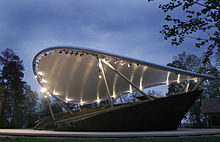
Stagecraft is a generic term referring to the technical aspects of theatrical, film, and video production. It includes, but is non express to, constructing and rigging scenery, hanging and focusing of lighting, design and procurement of costumes, makeup, procurement of props, stage management, and recording and mixing of sound. Stagecraft is distinct from the wider umbrella term of scenography. Considered a technical rather than an artistic field, it relates primarily to the practical implementation of a designer's artistic vision.
In its virtually basic grade, stagecraft is managed by a single person (often the stage managing director of a smaller production) who arranges all scenery, costumes, lighting, and sound, and organizes the cast. At a more professional person level, for instance in modern Broadway houses, stagecraft is managed by hundreds of skilled carpenters, painters, electricians, stagehands, stitchers, wigmakers, and the similar. This modern grade of stagecraft is highly technical and specialized: it comprises many sub-disciplines and a vast trove of history and tradition. The majority of stagecraft lies between these two extremes. Regional theatres and larger community theatres will generally have a technical director and a complement of designers, each of whom has a direct hand in their respective designs.
Sub-categories and organisation [edit]
There are many modern theatre movements which go almost producing theatre in a variety of ways. Theatrical enterprises vary enormously in sophistication and purpose. People who are involved vary from novices and hobbyists (in community theatre) to professionals (in Broadway and similar productions). Theatre can be performed with a shoestring budget or on a m calibration with multimillion-dollar budgets. This diversity manifests in the abundance of theatre sub-categories, which include:
- Broadway theatre and West Stop theatre
- Street theatre
- Community theatre
- Playback theatre
- Dinner theater
- Fringe theatre
- Off-Broadway and Off West End
- Off-Off-Broadway
- Regional theatre in the United States
- Touring theatre
- Summer stock theatre
Repertory companies [edit]

While most mod theatre companies rehearse i piece of theatre at a time, perform that piece for a set "run", retire the piece, and begin rehearsing a new show, repertory companies rehearse multiple shows at one time. These companies are able to perform these various pieces upon request and often perform works for years before retiring them. Most trip the light fantastic companies operate on this repertory system. The Royal National Theatre in London performs on a repertory system.
Repertory theatre by and large involves a grouping of similarly accomplished actors, and relies more on the reputation of the group than on an individual star actor. It as well typically relies less on strict control by a director and less on adherence to theatrical conventions, since actors who have worked together in multiple productions tin can reply to each other without relying every bit much on convention or external direction.[97]
Producing vs. presenting [edit]

In order to put on a piece of theatre, both a theatre company and a theatre venue are needed. When a theatre company is the sole company in residence at a theatre venue, this theatre (and its corresponding theatre visitor) are called a resident theatre or a producing theatre, because the venue produces its own work. Other theatre companies, as well as dance companies, who do not take their ain theatre venue, perform at rental theatres or at presenting theatres. Both rental and presenting theatres have no total-time resident companies. They practise, withal, sometimes have one or more part-time resident companies, in addition to other independent partner companies who arrange to use the space when available. A rental theatre allows the independent companies to seek out the space, while a presenting theatre seeks out the independent companies to support their work by presenting them on their stage.
Some operation groups perform in non-theatrical spaces. Such performances tin can take place outside or inside, in a non-traditional performance space, and include street theatre, and site-specific theatre. Non-traditional venues can be used to create more immersive or meaningful environments for audiences. They can sometimes exist modified more heavily than traditional theatre venues, or tin accommodate dissimilar kinds of equipment, lighting and sets.[98]
A touring company is an independent theatre or dance company that travels, ofttimes internationally, existence presented at a unlike theatre in each city.
Unions [edit]
At that place are many theatre unions including: Actors' Equity Clan (for actors and phase managers), the Stage Directors and Choreographers Society (SDC), and the International Brotherhood of Theatrical Phase Employees (IATSE, for designers and technicians). Many theatres require that their staff be members of these organizations.
See as well [edit]
- Acting
- Antitheatricality
- Blackness lite theatre
- Culinary theatre
- Illusionistic tradition
- Listing of awards in theatre
- List of playwrights
- List of theatre personnel
- List of theatre festivals
- List of theatre directors
- Lists of theatres
- Functioning art
- Puppetry
- Reader's theatre
- Site-specific theatre
- Theatre consultant
- Theatre for development
- Theater (structure)
- Theatre technique
- Theatrical manner
- Theatrical troupe
- World Theatre Day
Explanatory notes [edit]
- ^ Originally spelled theatre and teatre. From around 1550 to 1700 or subsequently, the most common spelling was theater. Between 1720 and 1750, theater was dropped in British English language, but was either retained or revived in American English (Oxford English Dictionary, 2nd edition, 2009, CD-ROM: ISBN 978-0-19-956383-8). Recent dictionaries of American English language list theatre every bit a less common variant, due east.g., Random House Webster's Higher Dictionary (1991); The American Heritage Dictionary of the English language Language, 4th edition (2006); New Oxford American Dictionary, third edition (2010); Merriam-Webster Lexicon (2011).
- ^ Drawing on the "semiotics" of Charles Sanders Peirce, Pavis goes on to advise that "the specificity of theatrical signs may prevarication in their ability to apply the iii possible functions of signs: as icon (mimetically), as alphabetize (in the situation of enunciation), or every bit symbol (as a semiological system in the fictional style). In effect, theatre makes the sources of the words visual and concrete: it indicates and incarnates a fictional world by means of signs, such that by the finish of the process of signification and symbolization the spectator has reconstructed a theoretical and aesthetic model that accounts for the dramatic universe."[2]
- ^ Brownish writes that ancient Greek drama "was essentially the cosmos of classical Athens: all the dramatists who were subsequently regarded as classics were active at Athens in the 5th and 4th centuries BCE (the time of the Athenian democracy), and all the surviving plays appointment from this period".[3] "The dominant culture of Athens in the 5th century", Goldhill writes, "tin can be said to have invented theatre".[5]
- ^ Goldhill argues that although activities that form "an integral part of the do of citizenship" (such as when "the Athenian citizen speaks in the Associates, exercises in the gymnasium, sings at the symposium, or courts a boy") each accept their "own authorities of display and regulation," however the term "operation" provides "a useful heuristic category to explore the connections and overlaps between these different areas of action".[9]
- ^ Taxidou notes that "well-nigh scholars at present call 'Greek' tragedy 'Athenian' tragedy, which is historically correct".[21]
- ^ Cartledge writes that although Athenians of the fourth century judged Aeschylus, Sophocles, and Euripides "equally the nonpareils of the genre, and regularly honoured their plays with revivals, tragedy itself was not only a 5th-century phenomenon, the product of a short-lived golden historic period. If not attaining the quality and stature of the fifth-century 'classics', original tragedies withal connected to exist written and produced and competed with in big numbers throughout the remaining life of the democracy—and beyond information technology".[24]
- ^ We have vii by Aeschylus, seven by Sophocles, and eighteen past Euripides. In addition, nosotros also have the Cyclops, a satyr play past Euripides. Some critics since the 17th century take argued that one of the tragedies that the classical tradition gives every bit Euripides'—Rhesus—is a 4th-century play by an unknown author; modern scholarship agrees with the classical government and ascribes the play to Euripides; encounter Walton (1997, 8, xix). (This dubiousness accounts for Brockett and Hildy's effigy of 31 tragedies.)
- ^ The theory that Prometheus Leap was non written by Aeschylus adds a fourth, anonymous playwright to those whose work survives.
- ^ Exceptions to this design were made, every bit with Euripides' Alcestis in 438 BCE. There were also dissever competitions at the Urban center Dionysia for the functioning of dithyrambs and, after 488–7 BCE, comedies.
- ^ Rush Rehm offers the following argument as evidence that tragedy was non institutionalised until 501 BCE: "The specific cult honoured at the City Dionysia was that of Dionysus Eleuthereus, the god 'having to practise with Eleutherae', a town on the edge between Boeotia and Attica that had a sanctuary to Dionysus. At some point Athens annexed Eleutherae—well-nigh likely later the overthrow of the Peisistratid tyranny in 510 and the democratic reforms of Cleisthenes in 508–07 BCE—and the cult-image of Dionysus Eleuthereus was moved to its new home. Athenians re-enacted the incorporation of the god'south cult every year in a preliminary rite to the City Dionysia. On the twenty-four hour period earlier the festival proper, the cult-statue was removed from the temple most the theatre of Dionysus and taken to a temple on the road to Eleutherae. That evening, subsequently cede and hymns, a torchlight procession carried the statue back to the temple, a symbolic re-creation of the god'south arrival into Athens, besides as a reminder of the inclusion of the Boeotian town into Attica. Every bit the name Eleutherae is extremely close to eleutheria, 'freedom', Athenians probably felt that the new cult was especially advisable for celebrating their own political liberation and democratic reforms."[33]
- ^ Jean-Pierre Vernant argues that in The Persians Aeschylus substitutes for the usual temporal distance between the audition and the age of heroes a spatial distance between the Western audition and the Eastern Persian culture. This commutation, he suggests, produces a similar upshot: "The 'celebrated' events evoked by the chorus, recounted by the messenger and interpreted past Darius' ghost are presented on stage in a legendary atmosphere. The light that the tragedy sheds upon them is not that in which the political happenings of the twenty-four hour period are usually seen; it reaches the Athenian theatre refracted from a distant world of elsewhere, making what is absent-minded seem present and visible on the stage"; Vernant and Vidal-Naquet (1988, 245).
- ^ Aristotle, Poetics, line 1449a: "One-act, as nosotros take said, is a representation of inferior people, non indeed in the full sense of the word bad, but the laughable is a species of the base or ugly. It consists in some blunder or ugliness that does not cause hurting or disaster, an obvious example being the comic mask which is ugly and distorted but non painful'."
- ^ The literal meaning of abhinaya is "to carry forward".
- ^ Francis Fergusson writes that "a drama, as distinguished from a lyric, is non primarily a composition in the verbal medium; the words result, as 1 might put it, from the underlying structure of incident and character. As Aristotle remarks, 'the poet, or "maker" should be the maker of plots rather than of verses; since he is a poet because he imiates, and what he imitates are actions'" (1949, eight).
- ^ See the entries for "opera", "musical theatre, American", "melodrama" and "Nō" in Banham 1998
- ^ While at that place is some dispute among theatre historians, it is probable that the plays by the Roman Seneca were not intended to be performed. Manfred by Byron is a good example of a "dramatic poem." See the entries on "Seneca" and "Byron (George George)" in Banham 1998.
- ^ Some forms of improvisation, notably the Commedia dell'arte, improvise on the ground of 'lazzi' or crude outlines of breathtaking activity (run into Gordon 1983 and Duchartre 1966). All forms of improvisation take their cue from their immediate response to ane another, their characters' situations (which are sometimes established in accelerate), and, ofttimes, their interaction with the audition. The classic formulations of improvisation in the theatre originated with Joan Littlewood and Keith Johnstone in the Great britain and Viola Spolin in the Usa; see Johnstone 2007 and Spolin 1999.
- ^ The first "Edwardian musical one-act" is usually considered to be In Town (1892), even though it was produced eight years earlier the beginning of the Edwardian era; encounter, for example, Fraser Charlton, "What are EdMusComs?" (FrasrWeb 2007, accessed May 12, 2011).
- ^ Meet Carlson 1993, Pfister 2000, Elam 1980, and Taxidou 2004. Drama, in the narrow sense, cuts across the traditional division between comedy and tragedy in an anti- or a-generic deterritorialization from the mid-19th century onwards. Both Bertolt Brecht and Augusto Boal ascertain their ballsy theatre projects (Not-Aristotelian drama and Theatre of the Oppressed respectively) against models of tragedy. Taxidou, even so, reads epic theatre equally an incorporation of tragic functions and its treatments of mourning and speculation.[76]
- ^ In 1902, Stanislavski wrote that "the author writes on paper. The actor writes with his trunk on the stage" and that the "score of an opera is not the opera itself and the script of a play is not drama until both are made flesh and claret on stage"; quoted by Benedetti (1999a, 124).
Citations [edit]
- ^ Carlson 1986, p. 36.
- ^ a b Pavis 1998, pp. 345–346.
- ^ a b c Chocolate-brown 1998, p. 441.
- ^ a b c Cartledge 1997, pp. iii–5.
- ^ a b c d Goldhill 1997, p. 54.
- ^ Cartledge 1997, pp. iii, 6.
- ^ Goldhill 2004, pp. 20–xx.
- ^ Rehm 1992, p. 3.
- ^ Goldhill 2004, p. 1.
- ^ Pelling 2005, p. 83.
- ^ Goldhill 2004, p. 25.
- ^ Pelling 2005, pp. 83–84.
- ^ a b Dukore 1974, p. 31.
- ^ a b Janko 1987, p. ix.
- ^ Ward 2007, p. i.
- ^ "Introduction to Theatre – Aboriginal Greek Theatre". novaonline.nvcc.edu.
- ^ Brockett & Hildy 2003, pp. 15–xix.
- ^ "Theatre | Chambers Dictionary of World History – Credo Reference". search.credoreference.com.
- ^ Ley 2007, p. 206.
- ^ Styan 2000, p. 140.
- ^ Taxidou 2004, p. 104.
- ^ Brockett & Hildy 2003, pp. 32–33.
- ^ Dark-brown 1998, p. 444.
- ^ Cartledge 1997, p. 33.
- ^ Brockett & Hildy 2003, p. 5.
- ^ Kovacs 2005, p. 379.
- ^ Brockett & Hildy 2003, p. fifteen.
- ^ Brockett & Hildy 2003, pp. 13–xv.
- ^ Dark-brown 1998, pp. 441–447.
- ^ a b c d Chocolate-brown 1998, p. 442.
- ^ Brockett & Hildy 2003, pp. xv–17.
- ^ Brockett & Hildy 2003, pp. xiii, fifteen.
- ^ Rehm 1992, p. 15.
- ^ Brockett & Hildy 2003, pp. xv–16.
- ^ Webster 1967.
- ^ Beacham 1996, p. 2.
- ^ Beacham 1996, p. 3.
- ^ Gassner & Allen 1992, p. 93.
- ^ a b c d Brandon 1993, p. xvii.
- ^ Brandon 1997, pp. 516–517.
- ^ a b c Richmond 1998, p. 516.
- ^ a b c d e Richmond 1998, p. 517.
- ^ a b Richmond 1998, p. 518.
- ^ Don Rubin; Chua Soo Pong; Ravi Chaturvedi; et al. (2001). The World Encyclopedia of Gimmicky Theatre: Asia/Pacific. Taylor & Francis. pp. 184–186. ISBN978-0-415-26087-9.
- ^ "PENGETAHUAN TEATER" (PDF), Kemdikbud
- ^ ""Wayang puppet theatre", Inscribed in 2008 (3.COM) on the Representative List of the Intangible Cultural Heritage of Humanity (originally proclaimed in 2003)". UNESCO. Retrieved October x, 2014.
- ^ James R. Brandon (2009). Theatre in Southeast Asia. Harvard University Press. pp. 143–145, 352–353. ISBN978-0-674-02874-half-dozen.
- ^ Kuritz 1988, p. 305.
- ^ a b "London'due south 10 oldest theatres". The Telegraph. Archived from the original on January xi, 2022. Retrieved Apr 6, 2020.
- ^ "From pandemics to puritans: when theatre shut down through history and how it recovered". The Stage.co.great britain . Retrieved December 17, 2020.
- ^ "The Actors remonstrance or complaint for the silencing for their profession, and banishment from their severall play-houses". Early on English Books Online. January 24, 1643.
- ^ Robinson, Scott R. "The English Theatre, 1642–1800". Scott R. Robinson Abode. CWU Department of Theatre Arts. Archived from the original on May 2, 2012. Retrieved Baronial vi, 2012.
- ^ "Women's Lives Surrounding Late 18th Century Theatre". English 3621 Writing by Women . Retrieved August seven, 2012.
- ^ Bermel, Albert. "Moliere – French Dramatist". Notice French republic. Grolier Multimedia Encyclopedia. Retrieved August 7, 2012.
- ^ Black 2010, pp. 533–535.
- ^ Matthew, Brander. "The Drama in the 18th Century". Moonstruch Drama Bookstore . Retrieved August 7, 2012.
- ^ Wilhelm Kosch, "Seyler, Abel", in Dictionary of German Biography, eds. Walther Killy and Rudolf Vierhaus, Vol. nine, Walter de Gruyter editor, 2005, ISBN 3-11-096629-8, p. 308.
- ^ "7028 end. Tartu Saksa Teatrihoone Vanemuise 45a, 1914-1918.a." Kultuurimälestiste register (in Estonian). Retrieved June 23, 2020.
- ^ Brockett & Hildy 2003, pp. 293–426.
- ^ a b Richmond, Swann & Zarrilli 1993, p. 12.
- ^ Brandon 1997, p. seventy.
- ^ Deal 2007, p. 276.
- ^ Moreh 1986, pp. 565–601.
- ^ Elam 1980, p. 98.
- ^ a b Pfister 2000, p. 11.
- ^ Fergusson 1968, pp. 2–3.
- ^ Burt 2008, pp. 30–35.
- ^ Rehm 1992, 150n7.
- ^ Jones 2003, pp. 4–eleven.
- ^ Kenrick, John (2003). "History of Stage Musicals". Retrieved May 26, 2009.
- ^ S.H. Butcher, [1], 2011
- ^ Banham 1998, p. 1118.
- ^ Williams 1966, pp. 14–16.
- ^ Williams 1966, p. xvi.
- ^ Williams 1966, pp. xiii–84.
- ^ a b Taxidou 2004, pp. 193–209.
- ^ Gordon 2006, p. 194.
- ^ Aristotle Poetics 1447a13 (1987, i).
- ^ Carlson 1993, p. 19.
- ^ Janko 1987, pp. 20, 7–ten.
- ^ Carlson 1993, p. 16.
- ^ Benedetti 1999, pp. 124, 202.
- ^ Benedetti 2008, p. 6.
- ^ Carnicke 1998, p. 162.
- ^ Gauss 1999, p. ii.
- ^ a b Banham 1998, p. 1032.
- ^ Carnicke 1998, p. 1.
- ^ Counsell 1996, pp. 24–25.
- ^ Gordon 2006, pp. 37–40.
- ^ Leach 2004, p. 29.
- ^ a b Counsell 1996, p. 25.
- ^ Carnicke 1998, pp. i, 167.
- ^ Counsell 1996, p. 24.
- ^ Milling & Ley 2001, p. 1.
- ^ Benedetti 2005, pp. 147–148.
- ^ Carnicke 1998, pp. one, eight.
- ^ Peterson 1982.
- ^ Alice T. Carter, "Non-traditional venues can inspire fine art, or only not bad performances Archived 2010-09-03 at the Wayback Auto", Pittsburgh Tribune-Review, July vii, 2008. Retrieved February 12, 2011.
Full general sources [edit]
- Banham, Martin, ed. (1998) [1995]. The Cambridge Guide to Theatre. Cambridge: Cambridge University Press. ISBN0-521-43437-viii.
- Beacham, Richard C. (1996). The Roman Theatre and Its Audition. Cambridge, MA: Harvard University Press. ISBN978-0-674-77914-3.
- Benedetti, Jean (1999) [1988]. Stanislavski: His Life and Art (Revised ed.). London: Methuen. ISBN0-413-52520-one.
- Benedetti, Jean (2005). The Art of the Thespian: The Essential History of Acting, From Classical Times to the Present Solar day. London: Methuen. ISBN0-413-77336-1.
- Benedetti, Jean (2008). "Stanislavski on Stage". In Dacre, Kathy; Fryer, Paul (eds.). Stanislavski on Stage. Sidcup, Kent: Stanislavski Heart Rose Bruford Higher. pp. 6–ix. ISBNane-903454-01-8.
- Black, Joseph, ed. (2010) [2006]. The Broadview Anthology of British Literature: Volume 3: The Restoration and the Eighteenth Century. Canada: Broadview Press. ISBN978-1-55111-611-2.
- Brandon, James R. (1993) [1981]. "Introduction". In Baumer, Rachel Van Chiliad.; Brandon, James R. (eds.). Sanskrit Theatre in Performance. Delhi: Motilal Banarsidass. pp. xvii–xx. ISBN978-81-208-0772-three.
- Brandon, James R., ed. (1997). The Cambridge Guide to Asian Theatre (2nd, revised ed.). Cambridge: Cambridge University Printing. ISBN978-0-521-58822-5.
- Brockett, Oscar G. & Hildy, Franklin J. (2003). History of the Theatre (Ninth, International ed.). Boston: Allyn and Bacon. ISBN0-205-41050-ii.
- Brown, Andrew (1998). "Hellenic republic, Ancient". In Banham, Martin (ed.). The Cambridge Guide to Theatre (Revised ed.). Cambridge: Cambridge Academy Press. pp. 441–447. ISBN0-521-43437-viii.
- Burt, Daniel S. (2008). The Drama 100: A Ranking of the Greatest Plays of All Time . New York: Facts on File. ISBN978-0-8160-6073-3.
- Carlson, Marvin (Fall 1986). "Psychic Polyphony". Periodical of Dramatic Theory and Criticism: 35–47.
- Carlson, Marvin (1993). Theories of the Theatre: A Historical and Critical Survey from the Greeks to the Present (Expanded ed.). Ithaca and London: Cornell University Printing. ISBN0-8014-8154-6.
- Carnicke, Sharon Marie (1998). Stanislavsky in Focus. Russian Theatre Annal series. London: Harwood Academic Publishers. ISBN90-5755-070-9.
- Cartledge, Paul (1997). "'Deep Plays': Theatre as Procedure in Greek Civic Life". In Easterling, P. Due east. (ed.). The Cambridge Companion to Greek Tragedy. Cambridge Companions to Literature series. Cambridge: Cambridge University Press. pp. iii–35. ISBN0-521-42351-one.
- Counsell, Colin (1996). Signs of Performance: An Introduction to Twentieth-Century Theatre. London and New York: Routledge. ISBN978-0-415-10643-6.
- Deal, William E. (2007). Handbook to Life in Medieval and Early Modern Japan. Oxford: Oxford University Press. ISBN978-0-xix-533126-4.
- Duchartre, Pierre Louis (1966) [1929]. The Italian One-act: The Improvisation Scenarios Lives Attributes Portraits and Masks of the Illustrious Characters of the Commedia dell'Arte . Translated past Randolph T. Weaver. New York: Dover Publications. ISBN0-486-21679-nine.
- Dukore, Bernard F., ed. (1974). Dramatic Theory and Criticism: Greeks to Grotowski. Florence, KY: Heinle & Heinle. ISBN978-0-03-091152-ane.
- Elam, Keir (1980). The Semiotics of Theatre and Drama. New Accents series. London and New York: Routledge. ISBN978-0-415-03984-0.
- Fergusson, Francis (1968) [1949]. The Thought of a Theater: A Study of 10 Plays, The Fine art of Drama in a Irresolute Perspective . Princeton, NJ: Princeton Academy Press. ISBN0-691-01288-1.
- Gassner, John & Allen, Ralph Thousand. (1992) [1964]. Theatre and Drama in the Making. New York: Applause Books. ISBNone-55783-073-8.
- Gauss, Rebecca B. (1999). Lear's Daughters: The Studios of the Moscow Art Theatre 1905–1927. American University Studies, Ser. 26 Theatre Arts. Vol. 29. New York: Peter Lang. ISBN978-0-8204-4155-ix.
- Goldhill, Simon (1997). "The Audition of Athenian Tragedy". In Easterling, P. E. (ed.). The Cambridge Companion to Greek Tragedy. Cambridge Companions to Literature series. Cambridge: Cambridge University Press. pp. 54–68. ISBN0-521-42351-1.
- Goldhill, Simon (2004). "Plan Notes". In Goldhill, Simon; Osborne, Robin (eds.). Performance Culture and Athenian Democracy (New ed.). Cambridge: Cambridge University Press. pp. i–29. ISBN978-0-521-60431-iv.
- Gordon, Mel (1983). Lazzi: The Comic Routines of the Commedia dell'Arte. New York: Performing Arts Periodical. ISBN0-933826-69-9.
- Gordon, Robert (2006). The Purpose of Playing: Modern Interim Theories in Perspective. Ann Arbor: University of Michigan Press. ISBN978-0-472-06887-half-dozen.
- Aristotle (1987). Poetics with Tractatus Coislinianus, Reconstruction of Poetics II and the Fragments of the On Poets. Translated past Janko, Richard. Cambridge: Hackett. ISBN978-0-87220-033-3.
- Johnstone, Keith (2007) [1981]. Impro: Improvisation and the Theatre (revised ed.). London: Methuen. ISBN0-7136-8701-0.
- Jones, John Bush (2003). Our Musicals, Ourselves: A Social History of the American Musical Theatre. Hanover: Brandeis University Press. ISBN1-58465-311-half-dozen.
- Kovacs, David (2005). "Text and Transmission". In Gregory, Justina (ed.). A Companion to Greek Tragedy. Blackwell Companions to the Ancient World serial. Malden, MA and Oxford: Blackwell. pp. 379–393. ISBN1-4051-7549-4.
- Kuritz, Paul (1988). The Making of Theatre History. Englewood Cliffs, NJ: Prentice Hall. ISBN978-0-13-547861-5.
- Leach, Robert (2004). Makers of Mod Theatre: An Introduction. London: Routledge. ISBN978-0-415-31241-7.
- Ley, Graham (2007). The Theatricality of Greek Tragedy: Playing Space and Chorus. Chicago and London: University of Chicago Printing. ISBN978-0-226-47757-2.
- Milling, Jane; Ley, Graham (2001). Mod Theories of Performance: From Stanislavski to Boal. Basingstoke, Hampshire, and New York: Palgrave. ISBN978-0-333-77542-4.
- Moreh, Shmuel (1986). "Live Theater in Medieval Islam". In Sharon, Moshe (ed.). Studies in Islamic History and Civilization in Honour of Professor David Ayalon. Cana, Leiden: Brill. pp. 565–601. ISBN965-264-014-X.
- Pavis, Patrice (1998). Dictionary of the Theatre: Terms, Concepts, and Analysis . Translated past Christine Shantz. Toronto and Buffalo: University of Toronto Printing. ISBN978-0-8020-8163-6.
- Pelling, Christopher (2005). "Tragedy, Rhetoric, and Functioning Culture". In Gregory, Justina (ed.). A Companion to Greek Tragedy. Blackwell Companions to the Ancient World series. Malden, MA and Oxford: Blackwell. pp. 83–102. ISBN1-4051-7549-four.
- Peterson, Richard A. (1982). "Five Constraints on the Product of Culture: Police force, Technology, Market, Organizational Structure and Occupational Careers". The Journal of Popular Culture (16.2): 143–153.
- Pfister, Manfred (2000) [1977]. The Theory and Assay of Drama. European Studies in English Literature series. Translated by John Halliday. Cambridige: Cambridge University Printing. ISBN978-0-521-42383-0.
- Rehm, Rusj (1992). Greek Tragic Theatre. Theatre Production Studies. London and New York: Routledge. ISBN0-415-11894-eight.
- Richmond, Farley (1998) [1995]. "Bharat". In Banham, Martin (ed.). The Cambridge Guide to Theatre. Cambridge: Cambridge Academy Printing. pp. 516–525. ISBN0-521-43437-viii.
- Richmond, Farley P.; Swann, Darius L. & Zarrilli, Phillip B., eds. (1993). Indian Theatre: Traditions of Performance. University of Hawaii Printing. ISBN978-0-8248-1322-ii.
- Spolin, Viola (1999) [1963]. Improvisation for the Theater (Tertiary ed.). Evanston, Il: Northwestern University Press. ISBN0-8101-4008-X.
- Styan, J. 50. (2000). Drama: A Guide to the Study of Plays. New York: Peter Lang. ISBN978-0-8204-4489-5.
- Taxidou, Olga (2004). Tragedy, Modernity and Mourning. Edinburgh: Edinburgh University Printing. ISBN0-7486-1987-9.
- Teachout, Terry. "The Best Theater of 2021: The Curtain Goes Up Again". wsj. orangepolly. Retrieved March 3, 2022.
- Ward, A.C (2007) [1945]. Specimens of English Dramatic Criticism XVII–XX Centuries. The World's Classics series. Oxford: Oxford University Press. ISBN978-1-4086-3115-7.
- Webster, T. B. Fifty. (1967). "Monuments Illustrating Tragedy and Satyr Play". Bulletin of the Institute of Classical Studies (Supplement, with appendix) (2nd ed.). University of London (20): 3–190.
- Williams, Raymond (1966). Modern Tragedy. London: Chatto & Windus. ISBN0-7011-1260-3.
Farther reading [edit]
- Aston, Elaine, and George Savona. 1991. Theatre as Sign-Organization: A Semiotics of Text and Operation. London and New York: Routledge. ISBN 978-0-415-04932-0.
- Benjamin, Walter. 1928. The Origin of German Tragic Drama. Trans. John Osborne. London and New York: Verso, 1998. ISBN ane-85984-899-0.
- Brownish, John Russell. 1997. What is Theatre?: An Introduction and Exploration. Boston and Oxford: Focal P. ISBN 978-0-240-80232-nine.
- Bryant, Jye (2018). Writing & Staging A New Musical: A Handbook. Kindle Direct Publishing. ISBN 9781730897412.
- Carnicke, Sharon Marie. 2000. "Stanislavsky's System: Pathways for the Player". In Hodge (2000, eleven–36).
- Dacre, Kathy, and Paul Fryer, eds. 2008. Stanislavski on Stage. Sidcup, Kent: Stanislavski Centre Rose Bruford Higher. ISBN i-903454-01-8.
- Deleuze, Gilles and Félix Guattari. 1972. Anti-Œdipus. Trans. Robert Hurley, Marker Seem and Helen R. Lane. London and New York: Continuum, 2004. Vol. one. New Accents Ser. London and New York: Methuen. ISBN 0-416-72060-nine.
- Felski, Rita, ed. 2008. Rethinking Tragedy. Baltimore: Johns Hopkins Upward. ISBN 0-8018-8740-two.
- Harrison, Martin. 1998. The Language of Theatre. London: Routledge. ISBN 978-0878300877.
- Hartnoll, Phyllis, ed. 1983. The Oxford Companion to the Theatre. fourth ed. Oxford: Oxford UP. ISBN 978-0-19-211546-1.
- Hodge, Alison, ed. 2000. Twentieth-Century Thespian Training. London and New York: Routledge. ISBN 978-0-415-19452-five.
- Leach, Robert (1989). Vsevolod Meyerhold. Directors in Perspective series. Cambridge: Cambridge University Press. ISBN978-0-521-31843-3.
- Leach, Robert, and Victor Borovsky, eds. 1999. A History of Russian Theatre. Cambridge: Cambridge Upwardly. ISBN 978-0-521-03435-7.
- Meyer-Dinkgräfe, Daniel. 2001. Approaches to Interim: By and Nowadays. London and New York: Continuum. ISBN 978-0-8264-7879-5.
- Meyerhold, Vsevolod. 1991. Meyerhold on Theatre. Ed. and trans. Edward Braun. Revised edition. London: Methuen. ISBN 978-0-413-38790-5.
- Mitter, Shomit. 1992. Systems of Rehearsal: Stanislavsky, Brecht, Grotowski and Brook. London and NY: Routledge. ISBN 978-0-415-06784-3.
- O'Brien, Nick. 2010. Stanislavski In Practise. London: Routledge. ISBN 978-0-415-56843-2.
- Rayner, Alice. 1994. To Act, To Do, To Perform: Drama and the Phenomenology of Action. Theater: Theory/Text/Performance Ser. Ann Arbor: University of Michigan Press. ISBN 978-0-472-10537-three.
- Roach, Joseph R. 1985. The Player's Passion: Studies in the Science of Interim. Theater:Theory/Text/Performance Ser. Ann Arbor: U of Michigan P. ISBN 978-0-472-08244-5.
- Speirs, Ronald, trans. 1999. The Nascence of Tragedy and Other Writings. By Friedrich Nietzsche. Ed. Raymond Geuss and Ronald Speirs. Cambridge Texts in the History of Philosophy ser. Cambridge: Cambridge UP. ISBN 0-521-63987-5.
External links [edit]
 | Wikimedia Eatables has media related to Theatre. |
- Theatre Archive Project (United kingdom) British Library & University of Sheffield.
- Academy of Bristol Theatre Collection
- Music Hall and Theatre History of United kingdom and Ireland
jaramillosibleard.blogspot.com
Source: https://en.wikipedia.org/wiki/Theatre

Postar um comentário for "The Roots of Postmodern Theatre Can Be Located in the Arts Phenomenon Called"